AOSU Solar Security Camera System Guide: Closed-Loop, Not Cloud-Locked
Researched with AI · Being re-checked by the Operator

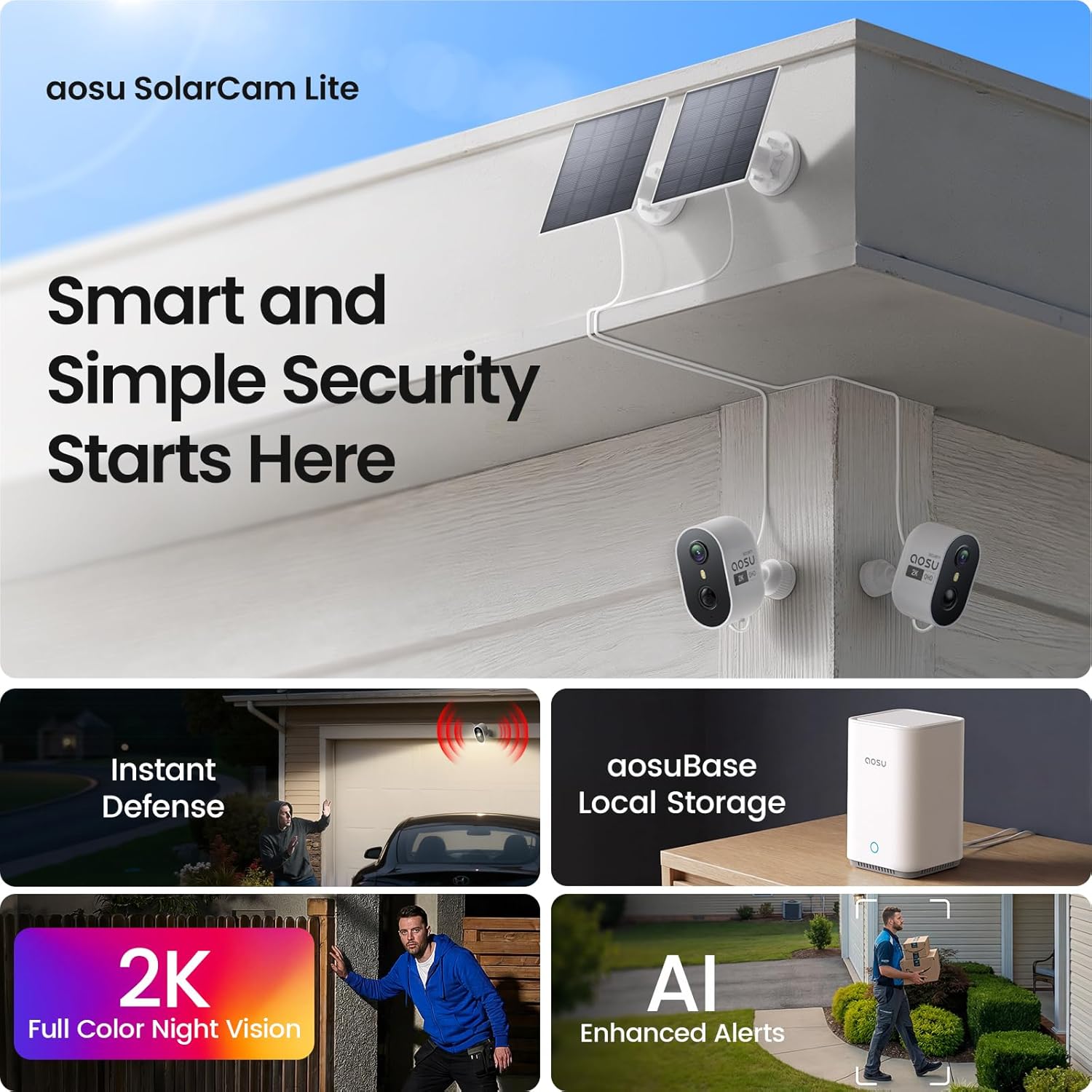 Researched pick · Researched with AI · not a hands-on review
Most "wireless" security cameras are wireless in name only — free of a power cord, but tied permanently to a monthly cloud subscription just to view or store footage. For a remote property, that's a second point of failure layered on top of the internet connection itself.
AOSU's 2-Cam Kit is genuinely closed-loop: solar and battery powered on the camera end, local storage with no subscription, and a base station that connects into the home network over a plain Ethernet cable rather than depending on the cloud to function at all.
Specs
- Resolution: 2K HD per camera
- Power: Solar panel + battery, wire-free cameras
- Storage: Local storage, no subscription required
- Base station connectivity: Ethernet (aosuBase); cameras connect wirelessly to the base
- Detection: PIR + AI human detection, cross-tracking between cameras
- Night vision: Full color
- Expandable: Same system scales to 3, 4, or 6-camera kits
Why it's the pick
The Ethernet connection on the base station is the detail that makes this fit the rest of this build specifically: it plugs straight into the network cabinet and switch already speced in this section, rather than depending on WiFi range at exactly the outdoor edges of the property where WiFi is weakest. No-subscription local storage also means the system keeps working if the internet connection itself goes down — genuinely closed-loop, not cloud-dependent dressed up as "wireless."
Where it falls short
Local storage means no off-site backup by default — footage lost to theft or damage of the base station itself is gone unless a separate backup routine is set up. Solar charging also depends on adequate sun exposure at each camera's mounting location; a heavily shaded spot may need the battery topped up manually more often than the panel can keep pace with.
Who it's for
Anyone adding security coverage to a remote property who wants it to keep functioning independent of a cloud subscription or a stable internet connection — which is exactly the situation a Starlink-fed remote home is already built around.
Sources

Guides are researched with AI and checked by the Operator. How KYRA.GG works →